Your Skin Has a Drainage System — Here's the 5-Minute Morning Habit That Keeps It Flowing
Most of us spend a decent chunk of money on serums, moisturizers, and exfoliants chasing that elusive healthy glow. But here's something worth considering: some of the most skin-conscious cultures in history didn't have any of that — and they weren't exactly walking around with dull, tired complexions.
Dry brushing is one of those practices that keeps resurfacing every few decades, gets dismissed as a trend, and then quietly earns its place back in the wellness conversation. That cycle makes sense once you understand what it's actually doing beneath the surface. This isn't just about scrubbing dead skin cells off your arms. It's about working with a body system most people don't think about until something goes wrong.
Ancient Roots, Surprisingly Modern Logic
The practice of mechanically stimulating the skin with a dry, coarse tool is genuinely old. In Ayurvedic medicine — the traditional healing system that originated in India thousands of years ago — a technique called garshana used raw silk gloves or a dry brush to invigorate the body and stimulate what practitioners described as sluggish energy and toxin buildup. Traditional Chinese medicine incorporated similar skin-stimulating methods as part of broader circulatory health practices. Ancient Greeks and Romans famously used strigils — curved metal tools — to scrape the skin after exercise, removing sweat, oil, and dead cells before bathing.
What's interesting is that none of these traditions had access to a microscope or a lymphatic anatomy textbook. But they arrived at a practice that, when you look at it through a modern physiological lens, makes a surprising amount of sense.
What's Actually Happening Under Your Skin
Your lymphatic system is essentially your body's internal drainage network. It's a web of vessels and nodes that carries lymph fluid — a substance packed with white blood cells and cellular waste — through your body and ultimately back into your bloodstream. Unlike your cardiovascular system, the lymphatic system doesn't have its own pump. It relies almost entirely on muscle movement, breathing, and external pressure to keep things flowing.
When lymphatic circulation slows down — which can happen from a sedentary lifestyle, poor sleep, chronic stress, or just not moving enough — fluid can accumulate. This shows up as puffiness, particularly around the face, ankles, and abdomen. It can contribute to that foggy, heavy feeling that's hard to explain but easy to recognize.
Dry brushing applies gentle, directional pressure to the skin in a way that mimics the kind of mechanical stimulation the lymphatic system responds to. The firm strokes — always moving toward the heart — help nudge lymph fluid through the vessels and encourage the natural drainage process. It also stimulates circulation in the capillaries just beneath the skin's surface, which is why your skin looks noticeably flushed and alive right after a session.
On top of that, the physical exfoliation clears away the layer of dead skin cells that accumulates daily, allowing moisturizers and oils to actually absorb rather than just sit on the surface.
Why It's Having a Moment Right Now
Dry brushing never fully disappeared, but it's showing up more prominently in wellness conversations lately — and the reasons are worth understanding. For one, people are increasingly skeptical of complicated, expensive skincare routines. There's a growing interest in practices that work with the body rather than layering synthetic products on top of it.
There's also a broader cultural shift toward recognizing the lymphatic system as a key player in overall health. Lymphatic drainage massage has gone from a niche post-surgery recovery tool to something wellness-conscious Americans are actively seeking out. Dry brushing offers a version of that same stimulation that anyone can do at home, in five minutes, with a brush that costs less than a single face serum.
It fits neatly into the kind of intentional morning routine that health-focused people are building — something physical, grounding, and genuinely beneficial that doesn't require an app or a subscription.
How to Do It Right
The technique matters more than people expect. Done correctly, dry brushing feels invigorating. Done wrong — too hard, in the wrong direction, with the wrong brush — it's just irritating.
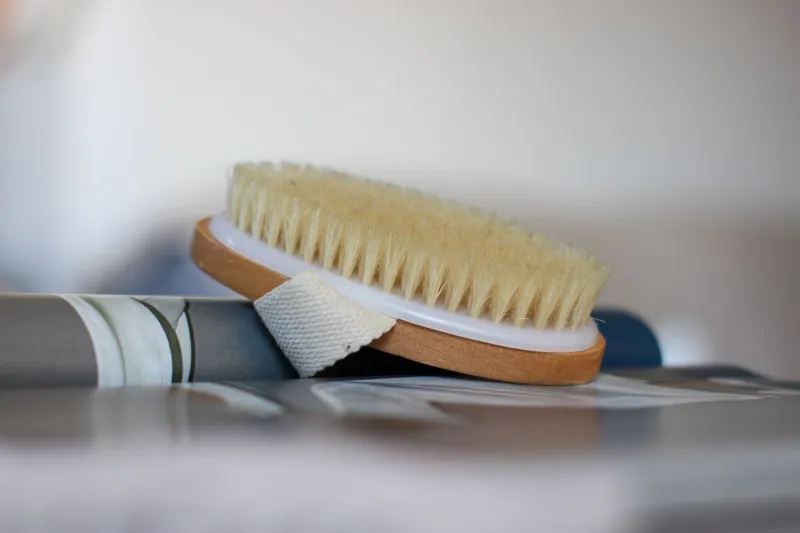
Choose the right brush. Look for a natural-bristle brush with firm but not scratchy bristles. Many have a long handle for reaching your back. For the face, use a separate, much softer brush or skip it entirely if your skin is sensitive.
Do it before you shower. Your skin should be completely dry — no lotion, no water. This is non-negotiable. Wet skin doesn't respond the same way and you'll lose most of the benefit.
Start at your feet and work upward. Use long, sweeping strokes moving toward your heart. On your legs, brush upward. On your arms, brush from your hands toward your shoulders. On your torso, brush toward your chest. The direction is important — you're encouraging lymph fluid to move toward the main drainage points near your collarbone.
Use light to medium pressure. You're not scrubbing a pot. The goal is stimulation, not abrasion. Your skin should feel warm and slightly pink, not red or irritated.
Spend about 30 to 60 seconds on each section. The whole routine should take around five minutes. You don't need to overdo it.
Follow up with a shower and moisturizer. Rinse off the loosened skin cells, then apply a nourishing oil or lotion while your skin is still slightly damp. Jojoba, coconut, or almond oil all work beautifully here.
A Few Things to Keep in Mind
Dry brushing isn't for everyone in every situation. If you have eczema, psoriasis, active breakouts, sunburn, or any open skin irritation, skip it or work around those areas. Sensitive skin types should start with very gentle pressure and see how they respond before making it a daily habit.
Also worth noting: dry brushing is supportive, not curative. It's not a treatment for lymphedema or any diagnosed lymphatic condition — those require medical care. What it is, for most healthy people, is a simple, accessible way to keep a neglected system moving a little better.
The Bigger Picture
There's something satisfying about a wellness practice that requires nothing more than a brush and five minutes of your morning. No powders to measure, no supplements to track, no special equipment. Just you, a natural-bristle brush, and a technique that humans have been using in various forms for thousands of years.
Your body already knows how to maintain itself — it just needs the right conditions and a little encouragement. Dry brushing is one of those small, consistent nudges that, over time, add up to skin that looks healthier, a body that feels less sluggish, and a morning routine that actually does something.
Give it two weeks. Your lymphatic system will notice.